
Creating a Stable Start
and a place to stay - today, tonight and tomorrow
Across the country a growing number of cities have created villages of small prefab houses to rapidly house individuals and families without housing.
Our Mission
To provide immediate residence and onsite or referral services to those who are unhoused in order to bridge the current economic and social gaps separating them from safe and dignified living.
The Goals of THP are:
- To provide shelter and services to those without housing:
- To evaluate and treat and/or refer clients for medical and psychosocial needs and other factors relevant to clients’ homelessness.
- To involve housed community members in this effort.
- To incentivize development of permanent affordable housing.
- To avoid institutionalizing this program, THP does not own land or permanent buildings.
“The minimum requirement for a dream is a safe place to lay your head.”
— OluTimehin Adegbeye
A Solvable Injustice:
Since 2017 homelessness has been rising in the US and recently it was further worsened by the upheaval resulting from the COVID-19 pandemic.
Multiple government programs have been created and ramped up to deal with the problem but have not been able to address the core issue: not enough immediately available housing.
Emergency shelters have better air conditioning than the sidewalk but lack dignity and clients experience theft and assault and risk infection in communal shelters.
Section 8 is a federal housing assistance program administered by the U.S. Department of Housing and Urban Development (HUD). Officially called the Housing Choice Voucher Program, it helps eligible renters afford housing. In Tucson, Arizona, waiting lists often prioritize households with greater need and may reflect local policy advocacy for disadvantaged renters; however, the program does not increase the total number of homes available.
The pandemic-related disruption in normal production of construction supplies is an additional obstacle to increasing new housing construction.
The Homing Project
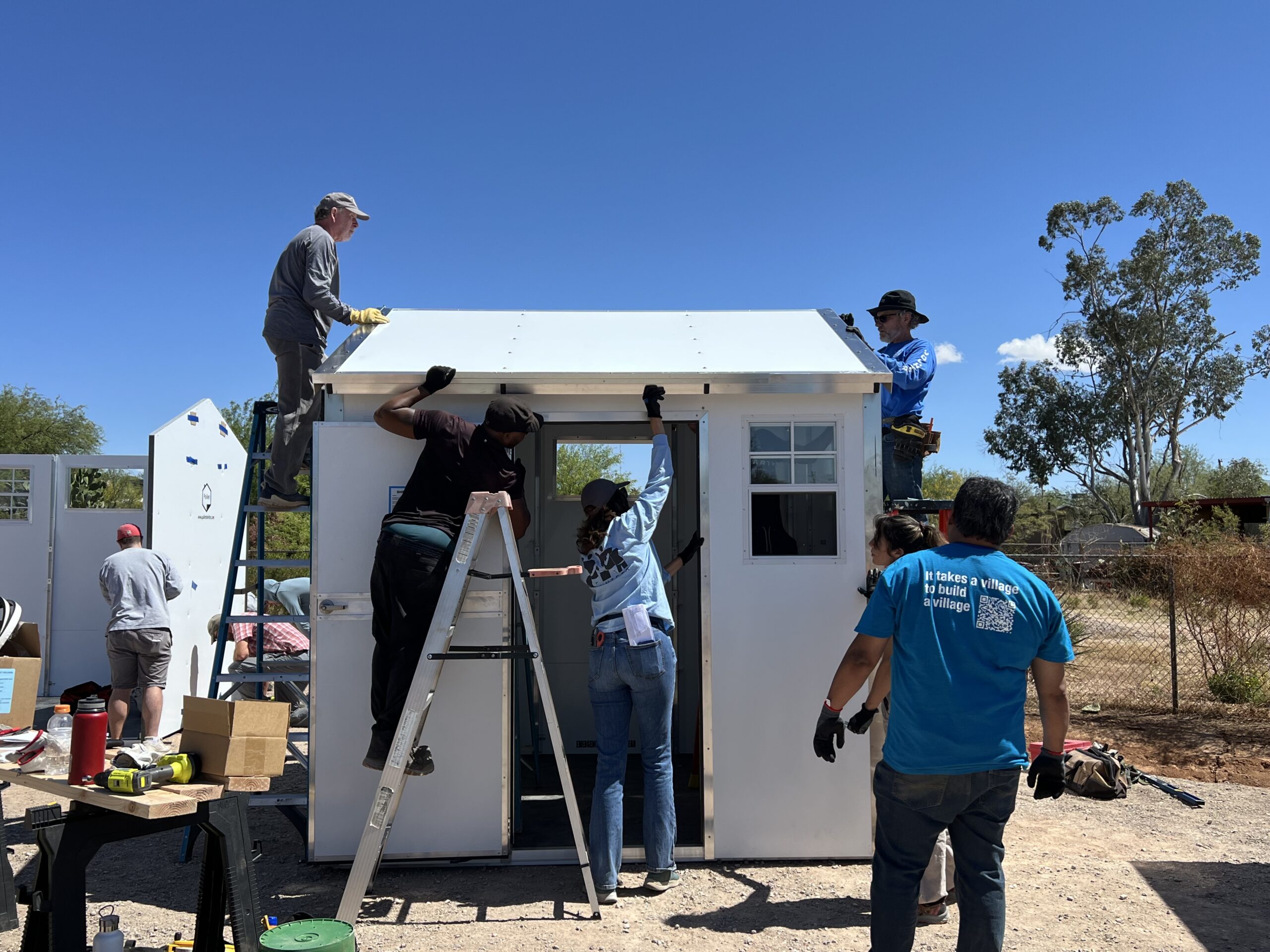
Across the country a growing number of cities have been creating villages of VERY tiny prefab houses (64 or 100 sq ft) to rapidly house homeless individuals and families.
In addition to rapid housing, by clustering homeless people with issues, such as mental illness and addiction, appropriate services can be efficiently provided for these conditions as well as job training and placement.
These very tiny houses (64 or 100 square feet) are each easily assembled in less than an hour.
They have heating, cooling, excellent insulation, 1-2 beds in single units, windows and a secure lock on each door.
On our 0.80 acre property we have 10 mini home and space to provide dining, laundry, and bathrooms are shared facilities in order to simplify utility installation and to provide opportunities for social interaction. The community is enclosed.
If not needed, the houses can be disassembled and flat-packed for moving to another site.
THP Structure
THP has a seven-member board, including a Chair, Vice-Chair, Secretary, and Treasurer. There is no paid administrative or executive staff. A term is 3 years; board members can serve three terms. The current board members’ qualifications encompass homeless services expertise, medical professionals, organizational experts, CPA, corporate experience, grant writing and information technology expertise.
The CEO, a semi-retired doctor, is unpaid. All other tasks are handled by non-staff volunteers. Volunteers do grant-writing, fundraising, website management, newsletter production, social media outreach, events, project management (the construction of the site), accounting, etc. The design and construction are done by paid consultants.
Founders
J Kristin Olson-Garewal MD
CO-FOUNDER & CEO
Co-Founder and CEO. Dr. Olson-Garewal retired from Medicine after a 46-year career primarily as a Medical Director of health plans and programs including State Medical Director for AHCCCS (Arizona’s experimental Medicaid Program) and University Medical Center’s Managed Care Program. While on the faculty of the University of Arizona’s College of Medicine, she was consultant to the Yaqui Nation, starting an innovative life-style diabetes program which to this day continues to result in ongoing regular physical activity starting in childhood and decreased community diabetes incidence.
Thanks to a grant from The Greenwall Foundation, from 2000-2002 Dr. Olson-Garewal studied medical bioethics with Allen Buchanan, a philosophical ethicist now at Duke University. During that time she chaired a panel discussion at a World Health Organization ethics conference in England and later convened a two-day conference of First Nation healers and leaders along with Federal government health program heads in the United States. Both events addressed the question: “Should Government Pay for Traditional Indigenous medicine?”
The final years of her medical practice were five years at an Arizona State men’s prison. She had become interested in prison healthcare after being part of a team doing a court-ordered medical audit at Arizona’s main State prison.
She has volunteered at free clinics in Tucson, Guatemala, Mexico, Kentucky and Tennessee (the US locations were with Remote Area Medicine, headquartered in Memphis, Tennessee). She received her BA and MD degrees through Boston University’s Honors Six Year Med Program.
Raj Garewal
CO-FOUNDER
In response to concern about the growing number of unsheltered Tucsonans, Mr. Garewal researched solutions on the internet. The villages of prefabricated individual shelters being used in Southern California stood out as the most rapid solution. After meeting with a number of non-profits and government agencies, he found that no entity was doing anything along those lines, and none were interested in starting. So he founded The Homing Project after persuading his physician-mother to do the grant applications. Mr. Garewal has worked with multiple programs for the unhoused and recovery communities. He had been most involved as a full-time volunteer at the Saint Joseph Homeless Center in Santa Monica, CA. He eventually turned down The Center’s job offer as a case manager in order to finish his undergraduate degree. Mr. Garewal received his BA in English from Loyola Marymount University and completed additional studies in Creative Writing at Warwick University, England. He is currently an insurance agent while applying to Law School.
Board of Directors
Kristin Davis
CHAIR
Since retiring in 2024 from the United Way as a grant writer, Kristin has been writing grants for The Homing Project. However, her primary career was more than 26 years in Risk Management in the banking industry. Most recently she served as a consultant to banks, on Risk Management issues and strategic marketing for 5 years. She was the Risk Manager and Senior Vice President for a major New York City bank for 15 years, before which a Vice President at a New Jersey Savings and Loan for three years. Prior to that, for four years, she was an underwriter for Chubb’s Department of Financial Institutions. Before becoming an underwriter, she lived in Paris, London and Brussels for seven years and worked at the Human Relations Institute as their Program and Public Relations Director in Brussels for two years. She began her career working as a social worker for the government for three years in CA and in NJ.
Born in Palo Alto, CA, Kristin graduated from the University of Redlands with a double major in English and History, and went straight into social work before her experience in Europe. Throughout her adult life, she has served on 11 Board of Directors, both corporate and non profit. During her Risk Management career she conducted more than 20 presentations to the banking world and insurance industry, and portrayed her expertise on the need to change the precepts and, thereby, introduced new innovations for Risk Management.
Janin Struminger
VICE CHAIR
Dr. Struminger received her BA from the University of Pennsylvania in 1985 and her medical degree from Temple University. This was followed by a residency in Internal Medicine and fellowship in infectious diseases at The Medical College of Pennsylvania, completing this training in 1996. She moved to Tucson in 1996 and from then until 2024 was in private practice in infectious diseases. Most recently, she was on staff at St. Mary’s, Northwest, and Oro Valley Hospitals. Past leadership roles include chair of infection prevention at Tucson Heart Hospital and chair of medicine at St. Mary’s Hospital. She has twice been chief-of-staff at St. Mary’s Hospital, an institution with a significant percentage of low income and underserved patients. Her volunteer activities include helping at a local women’s shelter (Sister Jose) and at Literacy Connects, where she teaches GED math class. She became interested in the work of The Homing Project in 2025, motivated by her concern for Tucson’s growing homeless population and having treated unhoused people in her medical career. She understands the challenges of staying healthy while unhoused and is convinced that The Homing Project’s housing model offers unhoused people a pathway to health and stability.
Joan Hall
TREASURER
Joan was born in Delaware, moved to Tucson at 16, and attended Canyon del Oro HS and then the U of A, where she received a Bachelor of Arts in Psychology and a Bachelor of Science in Biology in 1975. After attending graduate school at The American University in Washington DC, she received a Master’s degree in International Development in 1986. Subsequently she worked in the field of microfinance, living in Viet Nam, El Salvador, and West Bank (Occupied Territories), and traveling to many others as a consultant.
Teresa Cavendish
BOARD SECRETARY
Ms. Cavendish is a native Tucsonan, and a graduate from the University of Arizona with a degree in Business Administration and Information Technology. She served almost the entirety of her 38-year career with Catholic Community Services of Southern Arizona, lastly as its Chief Operating Officer.
During her tenure, Ms. Cavendish was involved in all areas of the organization to include organizational administration, information technology, facilities development and management, human resources, finance, immigration and refugee services, counseling and case management, low income housing, community nutrition services, child welfare, foster care and adoption, services for individuals with disabilities, domestic crisis services, and health services for the uninsured. Ms. Cavendish has broad experience working with property and insurance oversight, risk management, Board and community relations, program development and oversight, budget development and monitoring, grants compliance, and government relations. She was responsible for the redevelopment of two domestic crisis shelters in Sierra Vista and Douglas, securing Arizona Department of Housing funding and managing both construction projects from concept to completion. She also established and oversaw the Casa Alitas program, which provided hospitality and humanitarian aid to asylum-seeking individuals. Ms. Cavendish is passionate about meeting the needs of those experiencing homelessness in a way which upholds their dignity, independence, and self-empowerment.
Fernando Cardenas
BOARD MEMBER
Fernando has been a long time worker in the psychiatric health field who started working with less fortunate youth in the late 80’s at the Arizona Children’s Home. He has worked with all ages from children to geriatric psych patients. He is currently semi-retired and is still working as a psychiatric nurse in the addictions field focused on fentanyl addiction and recovery. He has been in recovery from substance and alcohol abuse for well over 3 decades and offers his knowledge to assist in the rehabilitation process for the less fortunate.
Conrad Grims
BOARD MEMBER
Conrad spent thirteen years working in child protective services in a rural isolated community in northern Vermont, first as a social worker, then casework supervisor, and finally as a district director. During his time in child protective services he developed several innovative procedures to further best practice in the field. Following his work in child protection, he worked for twenty years as a litigation paralegal in both civil and criminal law in Vermont and Arizona. He also spent four years as a social worker for a non-profit visiting nurse organization focusing on hospice, morbidity and maternal/child health. He has served on a number of not-for-profit boards, including Orleans-Essex VNA & Hospice, the Vermont Symphony Orchestra, and Friends of Sabino Canyon. Conrad enjoys hiking, reading, rooting for Penn State sports teams, and visiting friends and family in St. Thomas, USVI. As long as one person is involuntarily without safe housing, we have failed in our duty as a nation.
Beth Heinrich
BOARD MEMBER
Beth was born in western New York and earned her Bachelor of Science in Nursing from the State University of New York at Brockport. She began her 42-year healthcare career at the University of Michigan Medical Center and relocated with her family to Scottsdale, Arizona, in 1992. Throughout her career, Beth held a variety of leadership and administrative roles, leveraging her Master’s degree in Healthcare Administration in areas including program development, financial management, and project management.
Retiring from Mayo Clinic in Arizona after 24 years, Beth and her husband settled in Oro Valley. Before joining The Homing Project, she volunteered with an organization serving homeless and at-risk youth, gaining firsthand insight into the challenges individuals face in securing one of life’s most fundamental needs: stable housing.